
BLOG  Legal Angle
11/3/2025.

Written by Luka Jovanović
attorney-at-law and FSD Program Director
So What Do We Do Now?
So what do we do now? After the commemorative rally held on November 1stin Novi Sad and the start of Mrs. Harka’s hunger strike this question can no longer hang in the air.
As I write these lines the situation in Belgrade in front of the National Assembly building is getting increasingly tense and possibility of an open conflict becomes ever more likely, which makes finding the answer to this question that much more urgent.
Even though calling for elections is the most common answer to this dilemma, at this time there are 4 (four) obstacles that need to be overcome in order to create an environment in which it would be possible to hold elections of any kind.
1.Confirmation of the indictment for the canopy collapse in Novi Sad
Failure to confirm this indictment before the anniversary of the tragedy represents a lapse which yet again demonstrates the extent to which the Serbian judiciary is subservient to the dictates of political power which decides who’s innocent and who’s guilty – sometimes with no court involvement!
At the same time, the responsibility of the Higher Public Prosecutor's Office in Novi Sad which failed to defend its own independence in the handling of the canopy collapse case cannot be overlooked.
Through its aggressive non-response to the disinformation campaign claiming that the collapse of the canopy happened as a result of terrorist activity, as well as it’s concelebration in the state persecution of political and civil activists connected to the protests, it has lost near all credibility which is a crucial postulate of its independence and the confidence in the indictment which it has filled.
Confirmation of that indictment would not in and of itself put a stop to the newest wave of the crisis, but it would put a stop to the campaign –orchestrated by government officials and their media sycophants –of sowing doubt about what actually happened that day.
2.Reforming of the special police strike team that collaborated with the Prosecutor for Organized Crime
The disbanding of this strike team, under the guise of a new systematization of work posts, might well have been the most overt attempt by the government aimed at obstructing the investigation into the financial malfeasance surrounding the infrastructure projects of which the reconstruction the train station building in Novi Sad was also a part of.
Reforming this team (in the same composition!) would be a clear signal to the domestic public as well as Serbia’s international partners that Serbia has the institutional capacity and political will to see that this case reaches its conclusion within the court system.
3.Stopping the trials against STAV and PSG activists before the Higher Court in Novi Sad
Even though this isn’t the only criminal proceeding against civil activists engaged in protests throughout Serbia, the case against the STAV and PSG activists is the most significant since that is the casein which the government demonstrated to what lengths it is willing to go in its political clash with the increasingly massive protests.
Dubious charges, abuse of the secret service, in sync with the complete instrumentalization of the media aimed at corroborating the prosecutions’ claims – all an attempt to frame a narrative which is supposed to justify further repression of the state and an even more unscrupulous instrumentalization of the levers of state coercion.
This trial must be put to rest – along with all the other political trials – either by the dropping of all charges or through a presidential decree. Their continuation would not only undermine the basic liberties guaranteed to all of Serbia’s citizens, but would also call into question the legitimacy of an election that is supposed to take place in tandem with the state persecution of political organizations that are participating in said elections.
4.Dissolution of “Chaciland”
Much has already been said about this gathering that stretches from the National Assembly building up to the President’s offices, it’s(i)legality as well as its participants. It has long since become a place that people avoid in Belgrade because it is unsafe. Numerous attacks of its participants against undesirable passersby only confirms that estimation.
The police should have ordered the dispersal of that assembly after the first such incident in front of the National Assembly building. The police has, however, not done any such thing and there are no signs that it will do anything to that effect in the future without a prior political decision.
What needs to be said however is that the continued presence of this camp in the very heart of Belgrade shows that the government is not willing to forego non-sanctioned violence as a means to resolve the political crisis for which it is chiefly responsible and the lack of interest to find a solution through institutional means.
* * *
Only with the overcoming of these obstacles will it be possible to start a dialogue about elections and election conditions – which is not without its own set of issues. In spite of that, since it can’t be blind to all this, the government is refusing to take responsibility (it is even actively evading it!) for the solving of these problems and arrangement of election conditions befitting a society which deems itself a democracy.
Unfortunately, the events in front of the National Assembly building after November1st 2025, as well as the response of the police and the president to those events, have once again confirmed how distant the solution to this crisis and how close we are to point at which it metastasizes into something that can’t be fixed or controlled.
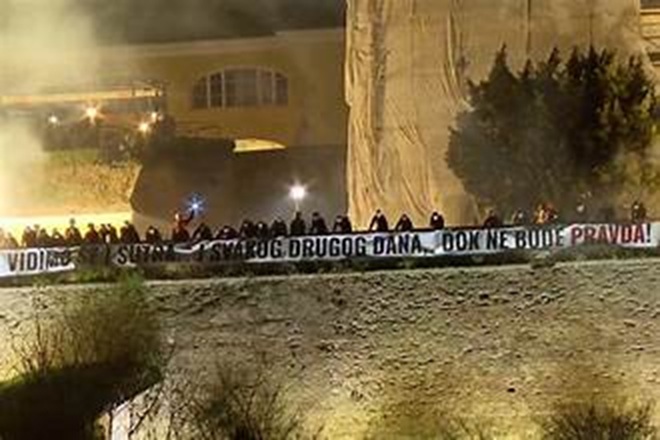
The banner: See you tomorrow and every other day until there is JUSTICE, Novi Sad 1.11.2025. courtesy TVN1infoBG

Molimo vas da razmislite o vašoj podršci
Forumu za bezbednost i demokratiju.
Možete nas podržati na sledeće načine
